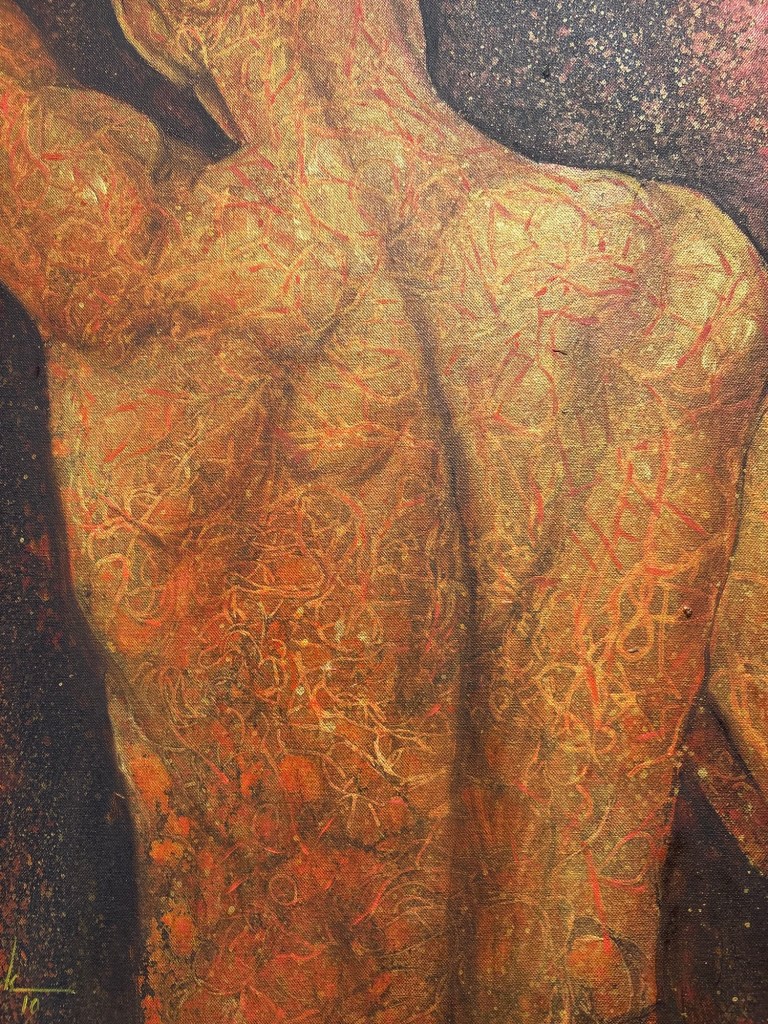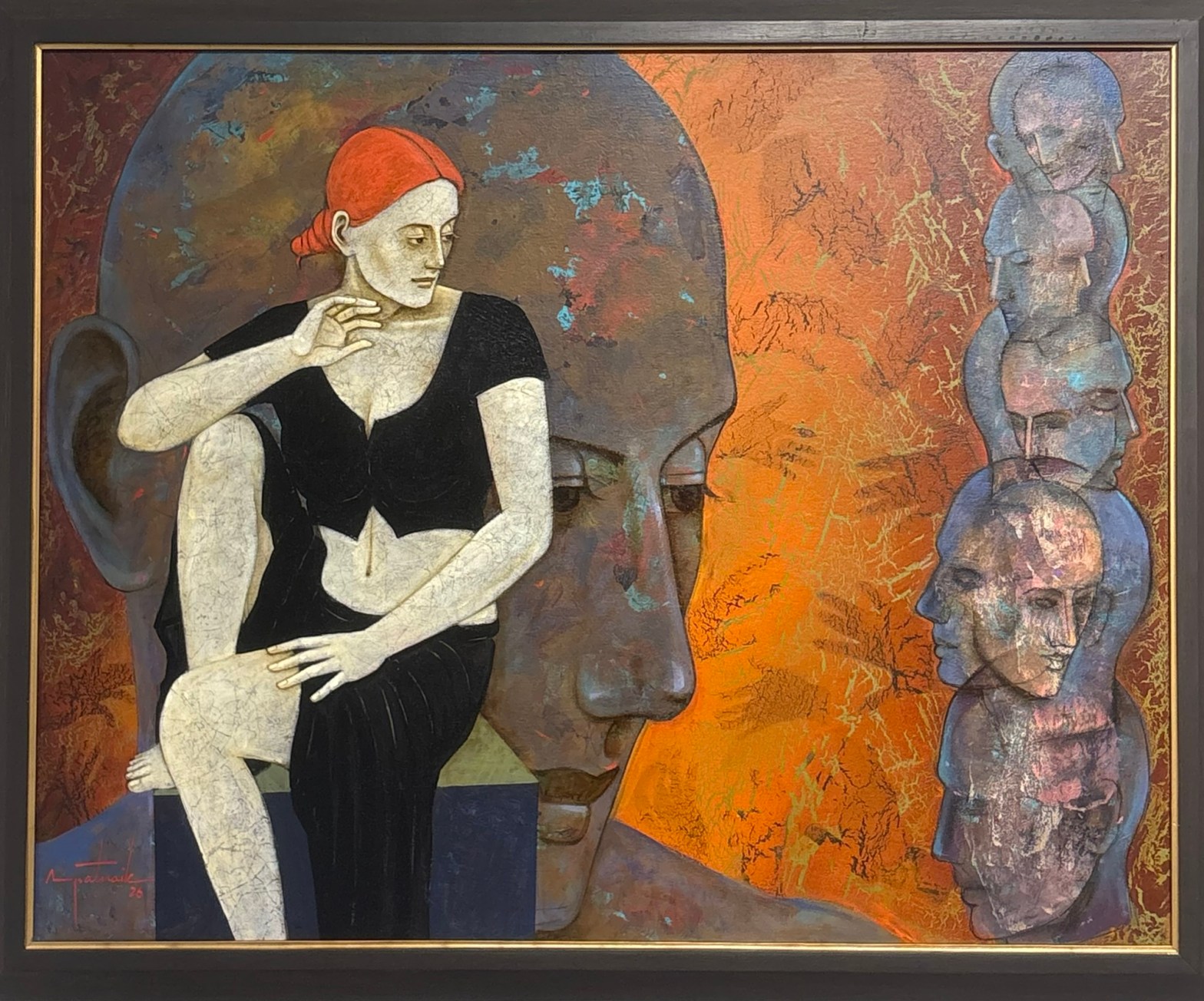
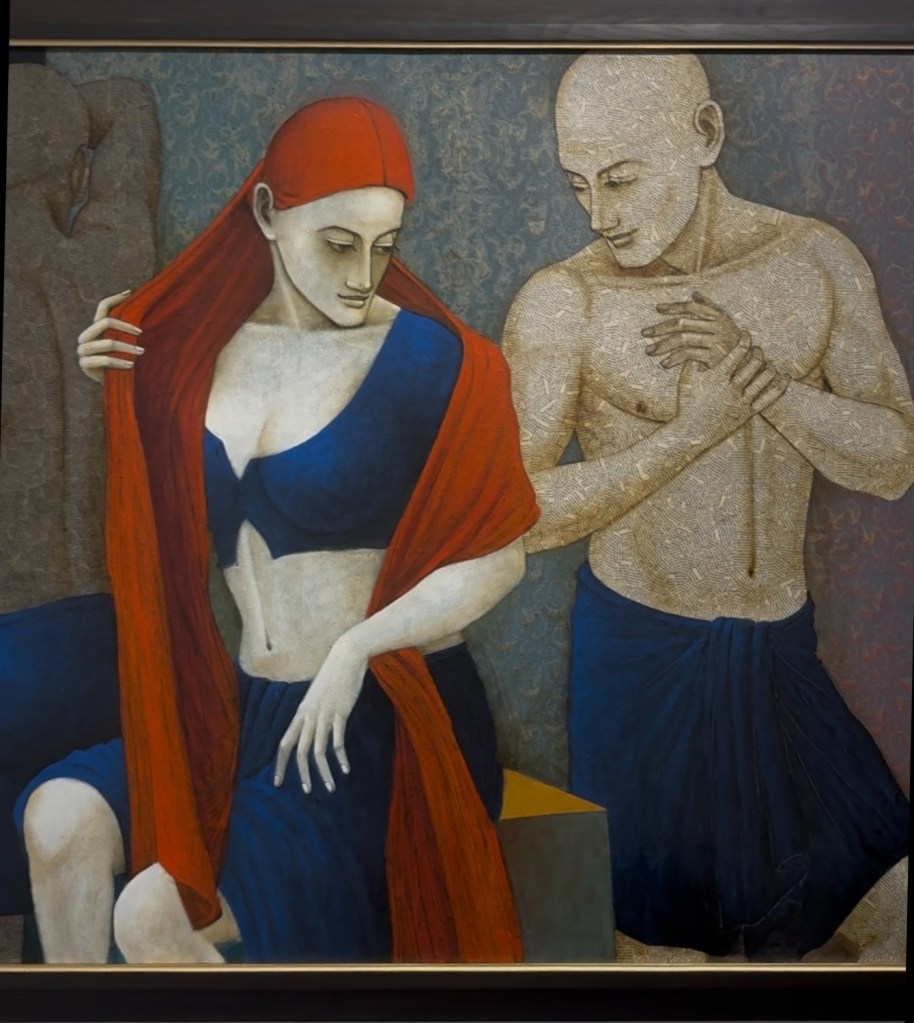
With winter beginning to hint at its arrival in Delhi’s air and people decked out in elaborate Navratri ensembles, I reached Bikaner House, New Delhi, on the seemingly quiet evening of 14 October 2026. Against the distant sounds of garba music and festive processions, I walked towards the quaint LTC Gallery. There, a red-haired woman on a canvas in a fleeting blue ensemble, casting a sultry gaze at the man beside her, greeted me. Before I could turn my attention to the artworks themselves, I found myself wondering whether the surface beneath the figures was, in fact, made of newspaper clippings. It was an unusual detail to be caught up in, but one that immediately drew me closer.
That was my introduction to Asit Kumar Patnaik’s Continuum: A 30-Year Retrospective, presented by Chawla Art Gallery and curated by Shibani Chawla. The flowing red-haired woman has almost become the artist’s visual signature, but this exhibition invites visitors to look beyond the image that has come to define him and discover the years of artistic exploration that led to it. Bringing together early sketches, unseen paintings and works from different periods, the retrospective offers a glimpse into the making of an artist, revealing how his visual language has evolved while retaining a persistent fascination with human identity and relationships.
Moving through the early works, I encountered an artist whose interest in the human condition was evident long before his paintings acquired their recognisable vibrancy. Images of women in striking ensembles sit alongside almost haunting portraits of heads, their features seemingly disfigured. While Patnaik is renowned for the vivid colours that draw viewers into his paintings, I was equally taken aback by the intricacy of his sketches. There is something intimate about encountering these earlier explorations; they allow you to look beyond the finished image and glimpse the artist’s process of observation and discovery.
As I moved through the exhibition’s different sections, the evolution of Patnaik’s practice became increasingly apparent. The red-haired woman remained a recurring presence, even as the treatment of figures, surfaces and compositions changed. One could easily spend hours standing before his paintings, attempting to decipher the complex emotions conveyed through their visual elements, studying the interplay of colours and, perhaps most unexpectedly for me, losing oneself in the textures and iconography that populate their backgrounds.
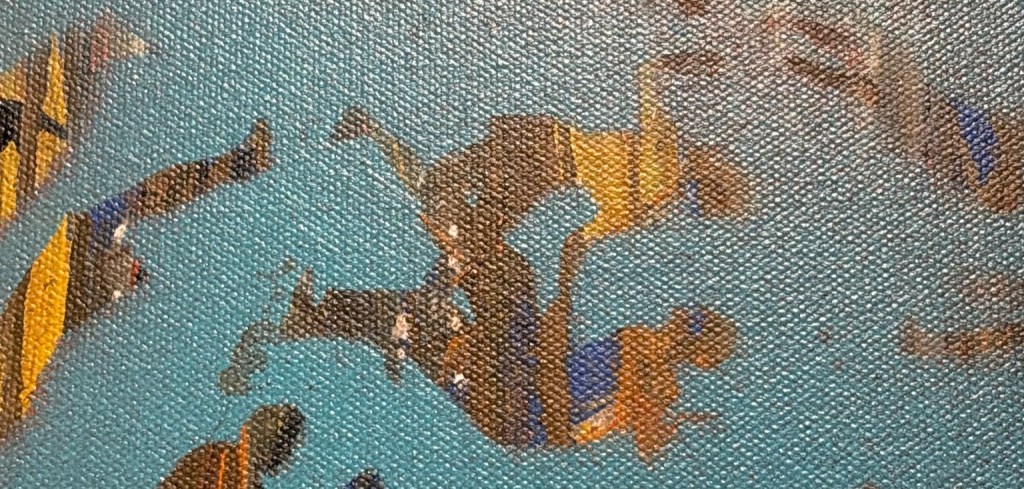
These details surprised me in the most pleasant way. The surfaces often seemed to hold an entire world of their own, with layers and visual references that rewarded closer inspection. In one instance, the iconic dance sequence from Pulp Fiction appears on the canvas as an additive element, an unexpected reference that made me pause and reconsider the many visual worlds coexisting within a single painting. Patnaik’s use of texture and material is not merely decorative; it adds another dimension to the emotional narratives unfolding before the viewer.
Yet, across these changing palettes and compositions, the red-haired woman remains central to the experience of the exhibition. Through his Man-Woman series, Patnaik explores the complexities of human relationships, capturing the emotions that accompany intimacy: desire, longing, companionship and misunderstanding. His figures often appear caught between closeness and distance, their gestures suggesting feelings that words may leave unsaid. As a viewer, you find yourself drawn into these moments, trying to understand what passes between the figures and what remains hidden beneath the surface.
Sushma K. Bahl writes, “The barely clad petite icon (red headed woman), confident and comfortable in her own skin could be the celestial beauty, the central figure in a world co-habited by men.”
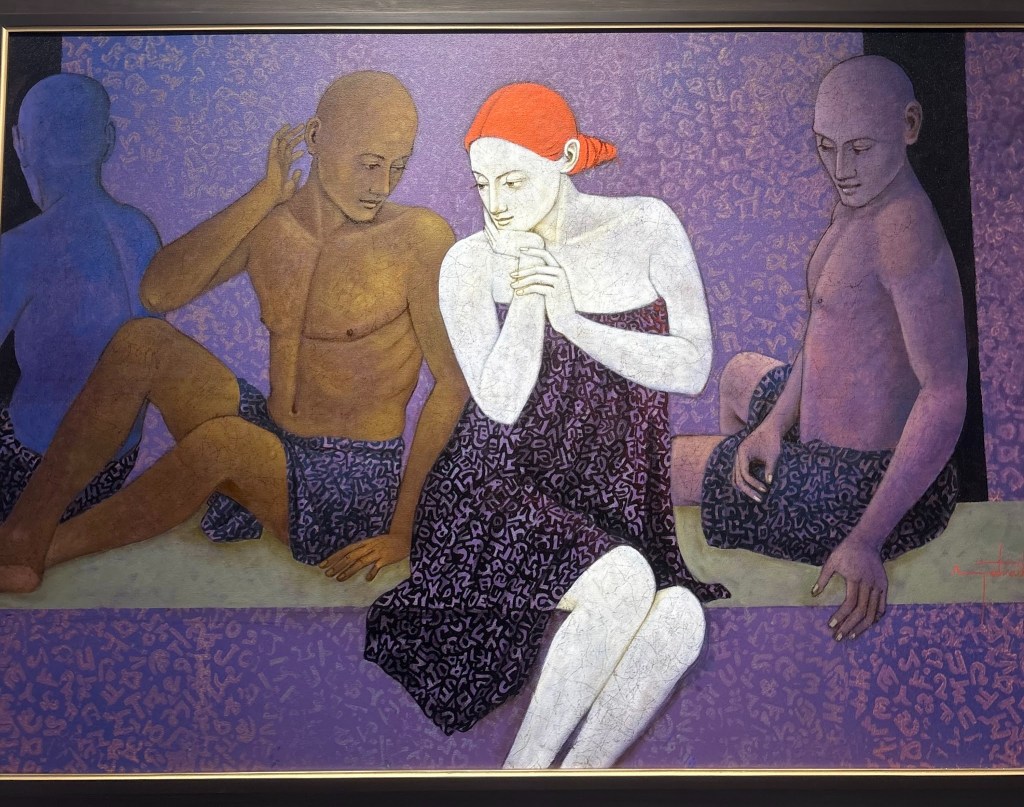
On my first reading of this wall text, I struggled to fully reconcile the interpretation with what I saw before me. The woman certainly appeared confident, but in many of the paintings, her sensuality seemed inseparable from the emotional worlds inhabited by the men around her. I found myself reading her through the moments she shared with them, as though her identity were partly shaped by their desires and the intimacy they seemed to offer. I could recognise her as the central figure, yet I was still looking at her through the lens of the man-woman relationship.
It was only when I reached the final section, displaying a series of ‘Thoughtscapes’, that something shifted. Suddenly, the focus was no longer on the moment shared between a man and a woman, but on the woman herself. Hands emerge from the canvas, almost reaching out to touch her, while she remains absorbed in her own world. The emotions persist, but the emphasis moves beyond sensuality. There is longing, hope and desire, rendered with an intensity that feels distinctly her own.
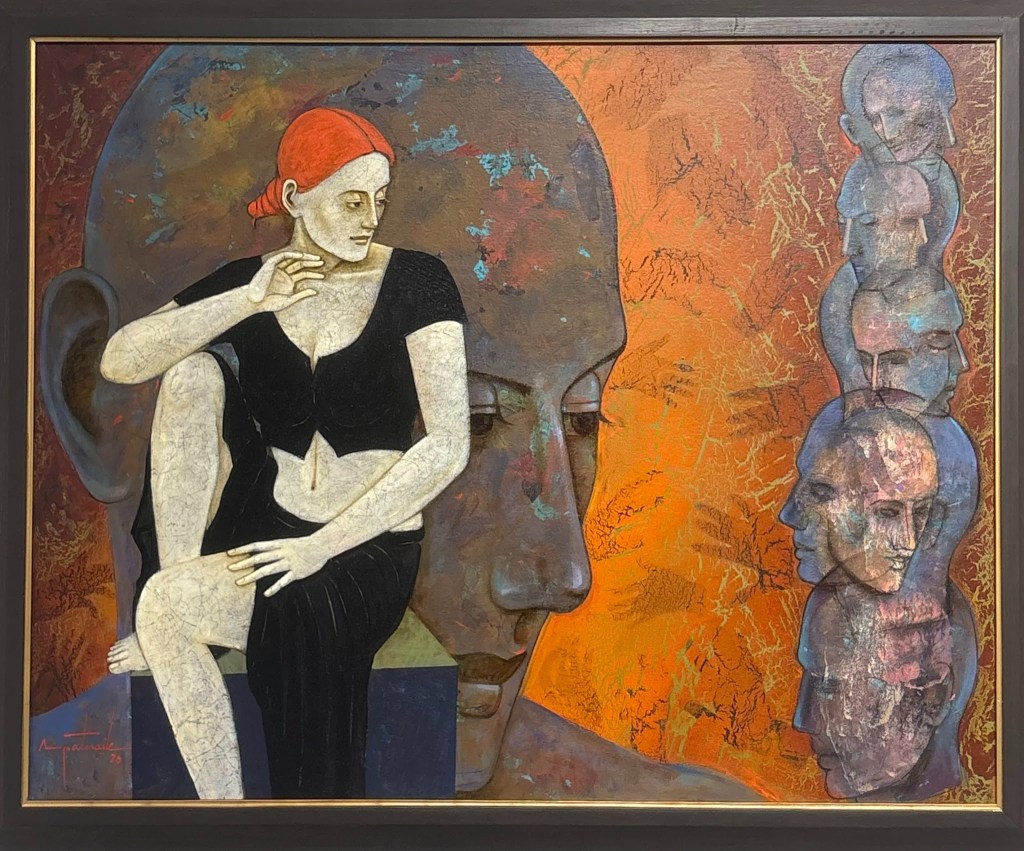
Standing before these works, I found myself thinking about identity beyond desirability: who are we when we are no longer looking at ourselves through the eyes of someone who wants us? Being wanted is, after all, a deeply human desire. Yet these paintings left me with the uncomfortable but necessary reminder that the desire to be wanted need not become the very thing that consumes us. There is a self that exists beyond the gaze of another, and perhaps the most compelling aspect of this final series is the suggestion that she is beginning to find it.
This shift in my understanding of the red-haired woman also made me think about her origins. Patnaik writes of observing women in Varanasi, their heads covered in sindoor, as they dipped into the Ganges to bathe, the vermilion washing away in the water. It is a striking image: something so transient becoming the starting point for a figure that would recur throughout decades of artistic practice. The red hair, initially so arresting as a visual element, begins to feel like an entry point into something more enduring. It is a reminder of how an everyday observation can grow into an artistic language through which an artist continues to explore the human condition.
I arrived intrigued by a red-haired woman and the curious textures surrounding her. I left thinking about the complicated relationship between intimacy and identity, and about the parts of ourselves that remain beyond another person’s gaze.
If you visit, resist the temptation to move through the gallery too quickly. Look beyond the colours, follow the textures, linger over the details in the backgrounds and allow yourself to return to a painting after you think you have understood it. Continuum: A 30-Year Retrospective is currently on view at Chawla Art Gallery, Saket, until 30 November 2026.